Field guide
How thick should a concrete driveway be?
Choose thickness from vehicle loads, base conditions and climate, then see what the extra inch costs.
Reviewed September 1, 2026 by Sam Johnson from the Concrete Calculators Editorial Team. Sources and planning assumptions are linked in the article.
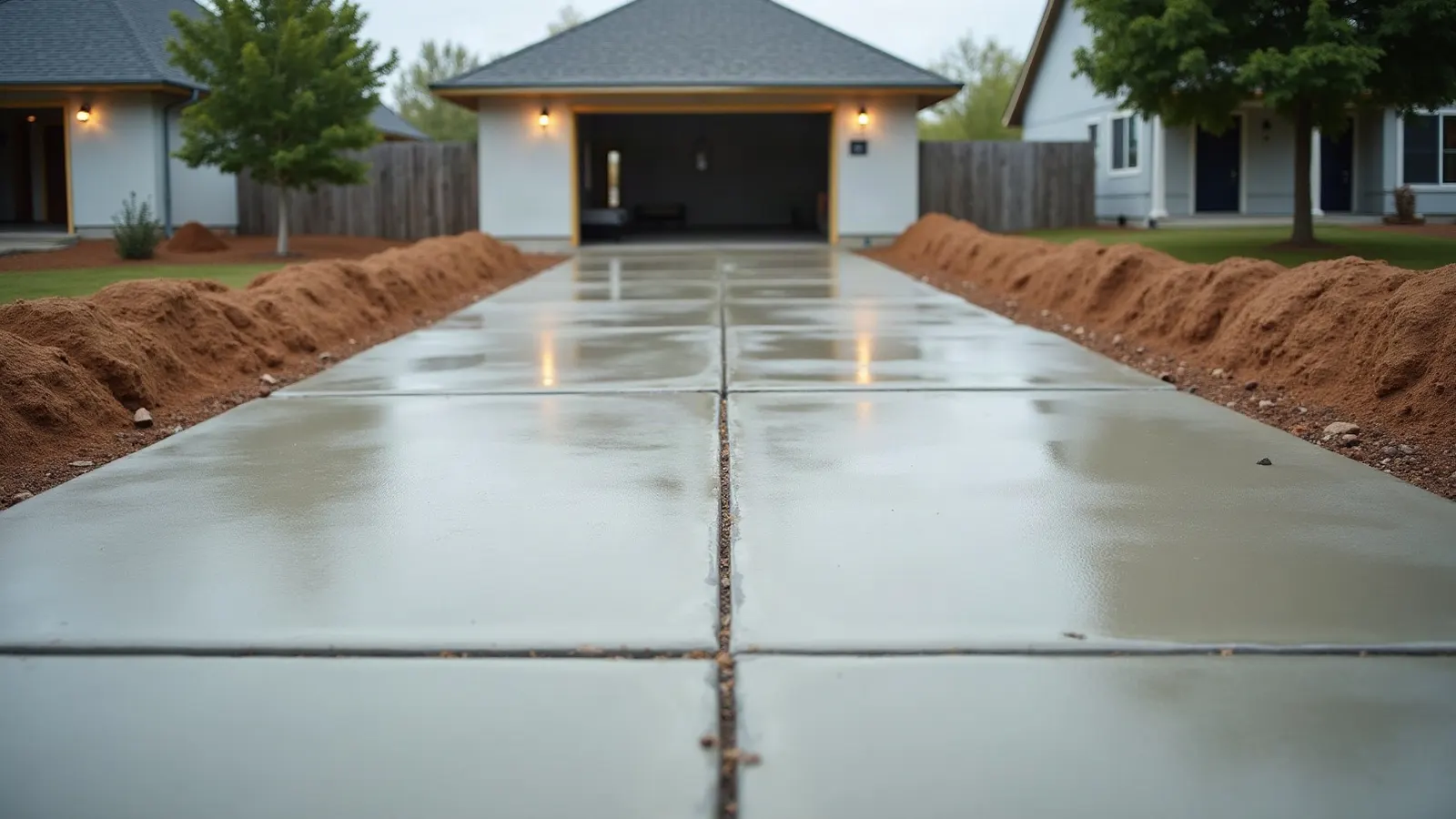
Four inches is the minimum that residential specs, including the Portland Cement Association's guidance and most municipal codes, accept for a driveway that carries passenger cars. Five inches is what you should actually pour. The extra inch raises the load capacity far more than it raises the bill, and driveways fail from loads and subgrade problems, not from age.
Here is the short version of the money. On a 16 by 40 ft driveway priced with our concrete slab cost calculator at default rates, going from 4 to 5 inches adds about $372 to a $5,383 job. That is a 7 percent premium for roughly 50 percent more bending strength, since a slab's capacity rises with the square of its thickness. Work out the yardage difference for your own dimensions with the concrete calculator before you talk to anyone.
Concrete driveway thickness by what parks on it
Match the concrete driveway to the heaviest thing that will ever sit on it, not the car you drive today. A moving truck, a concrete truck for the garage pour, or a loaded dumpster all count.
| What it carries | Thickness | Reinforcement | Notes |
|---|---|---|---|
| Cars and light SUVs | 4 in minimum | Wire mesh | The code floor. Fine on excellent base |
| Cars, pickups, occasional delivery truck | 5 in | Rebar grid, 18 in on center | The recommended pour for most homes |
| Heavy pickups, trailers, RVs | 6 in | Rebar grid | Consider 4,500 psi mix |
| Box trucks, equipment, farm use | 6 to 8 in | Engineered rebar layout | Get a design, not a calculator |
| The apron and street edge | Match slab, thickened to 8 in at the lip | Rebar | Takes turning loads and plow hits |
Where to thicken a concrete driveway
Two places deserve extra depth on any driveway. Thicken the outside edges, since edge loading is the most common crack starter, and thicken the apron where wheels turn and scrub. The slab cost calculator has a thickened edge option that prices this as extra concrete rather than a separate footing.
Driveway thickness by vehicle weight
Thickness requirements come from axle loads, not total vehicle weight. A 4 inch concrete driveway on compacted base handles axle loads around 2 tons all day, which covers every passenger vehicle. The trouble starts with single rear axle trucks: a loaded moving van or a ready mix truck puts 7 tons or more on one axle. One visit will not always crack a 4 inch slab, but repeated loads will, and a garbage truck visits weekly.
| Vehicle | Typical loaded weight | Safe on 4 in | Safe on 5 in | Safe on 6 in |
|---|---|---|---|---|
| Sedan or crossover | 2 to 3 tons | Yes | Yes | Yes |
| Full size pickup | 3 to 4 tons | Yes | Yes | Yes |
| Camper or boat trailer | 3 to 5 tons | Borderline | Yes | Yes |
| Delivery box truck | 7 to 10 tons | No | Occasional | Yes |
| Loaded ready mix truck | 30 tons or more | No | No | Keep it off |
How to read the vehicle weight table
Weights are typical published ranges, and the safe columns assume a compacted gravel base in good condition. A thick slab on mud is still a broken slab.
How climate changes a concrete driveway
In warm, dry climates a 4 inch slab on 4 inches of compacted crushed stone performs well. In freeze thaw country the slab thickness advice stays the same but everything under and inside it changes.
- Base depth grows to 6 inches, sometimes 8 on clay, so water drains instead of freezing and heaving the slab.
- The mix should be air entrained, at 4,000 psi or better. Many cold climate codes call for 4,500 psi for flatwork exposed to deicers.
- Joints matter more. Cut or tool control joints at 10 ft or less each way on a 4 inch slab, and never skip the isolation joint at the garage and the street.
- Deicing salt in the first winter is the classic surface killer on a new pour. Sand instead.
Base depth in freeze thaw climates
If your frost line is deep enough that fence posts heave, spend your next dollar on base and drainage before a sixth inch of concrete.
What concrete driveway thickness costs
All rows are a 16 by 40 ft driveway from the concrete slab cost calculator with broom finish, gravel base, rebar grid, labor and $165 per yard ready mix. Your local price will move the totals, not the gaps between them.
| Thickness | Concrete to order | Point estimate | Likely range |
|---|---|---|---|
| 4 in | 8.75 cu yd | $5,383 | $4,737 to $6,352 |
| 5 in | 11 cu yd | $5,755 | $5,064 to $6,790 |
| 6 in | 13.25 cu yd | $6,126 | $5,391 to $7,228 |
What each extra inch actually buys
The pattern is the point: each extra inch on this driveway costs about $370, because forms, base, labor and finishing do not change. Only the concrete line grows. Thickness is the cheapest strength you can buy on pour day and the most expensive thing to fix later, since the repair is demolition.
How thick your concrete driveway should be
Pour the concrete driveway at 5 inches and 4,000 psi, air entrained in freeze thaw climates, over at least 4 inches of compacted crushed stone, with a rebar grid at 18 inches on center and edges thickened to 8 inches. Drop to 4 inches only if the budget truly cannot stretch, and hold the line on base compaction if you do. Go to 6 inches when anything with a single rear axle will use the driveway on purpose.
Delivered rates, short load fees and standby charges are broken down in the concrete price per yard guide, and the concrete drying time guide covers how long to keep vehicles off once it is poured.
One number this guide does not settle is your soil. Expansive clay or soft fill can crack a concrete driveway at any thickness listed here, and a soils fix costs less than a re-pour. When in doubt, pay for an hour of local engineering advice before you pay for concrete.
Straight answers
Concrete driveway thickness questions
Open a question for the practical answer, including the assumptions behind the number.
Is 3 inches of concrete enough for a driveway?
No. Three inches sits below every residential spec we know of, cracks under ordinary axle loads, and leaves nothing for the surface wear that follows. If the budget is forcing 3 inches, pour a smaller driveway at 4 instead.
Do I need rebar in a concrete driveway?
At 4 inches, wire mesh controls shrinkage cracking and is the common spec. At 5 inches and up, or wherever trucks will stand, a rebar grid at 18 inches on center is cheap insurance. Neither substitutes for a compacted base.
How long before I can drive on a new driveway?
Keep cars off for 7 days. Concrete reaches roughly three quarters of its design strength in the first week under a proper cure, which is the common industry benchmark for light vehicle traffic. Keep heavy trucks off for a month.
How much more does 5 inches cost than 4?
On the 16 by 40 ft driveway priced in this guide, about $372 on a $5,383 job, roughly 7 percent. Forms, base, labor and finishing cost the same either way, so the extra inch is only the concrete itself.
Concrete tool library
Related concrete calculators
Use the calculator that matches the scope of your next pour.
Free Concrete Slab Cost Calculator
Slab pricing with finish, thickened edges and vapor barrier.
Open calculator →
Free Concrete Calculator
Cubic yards, bags and cost for five common concrete shapes.
Open calculator →
Free Concrete Pad Cost Calculator
Materials and labor price for a simple outdoor pad.
Open calculator →